
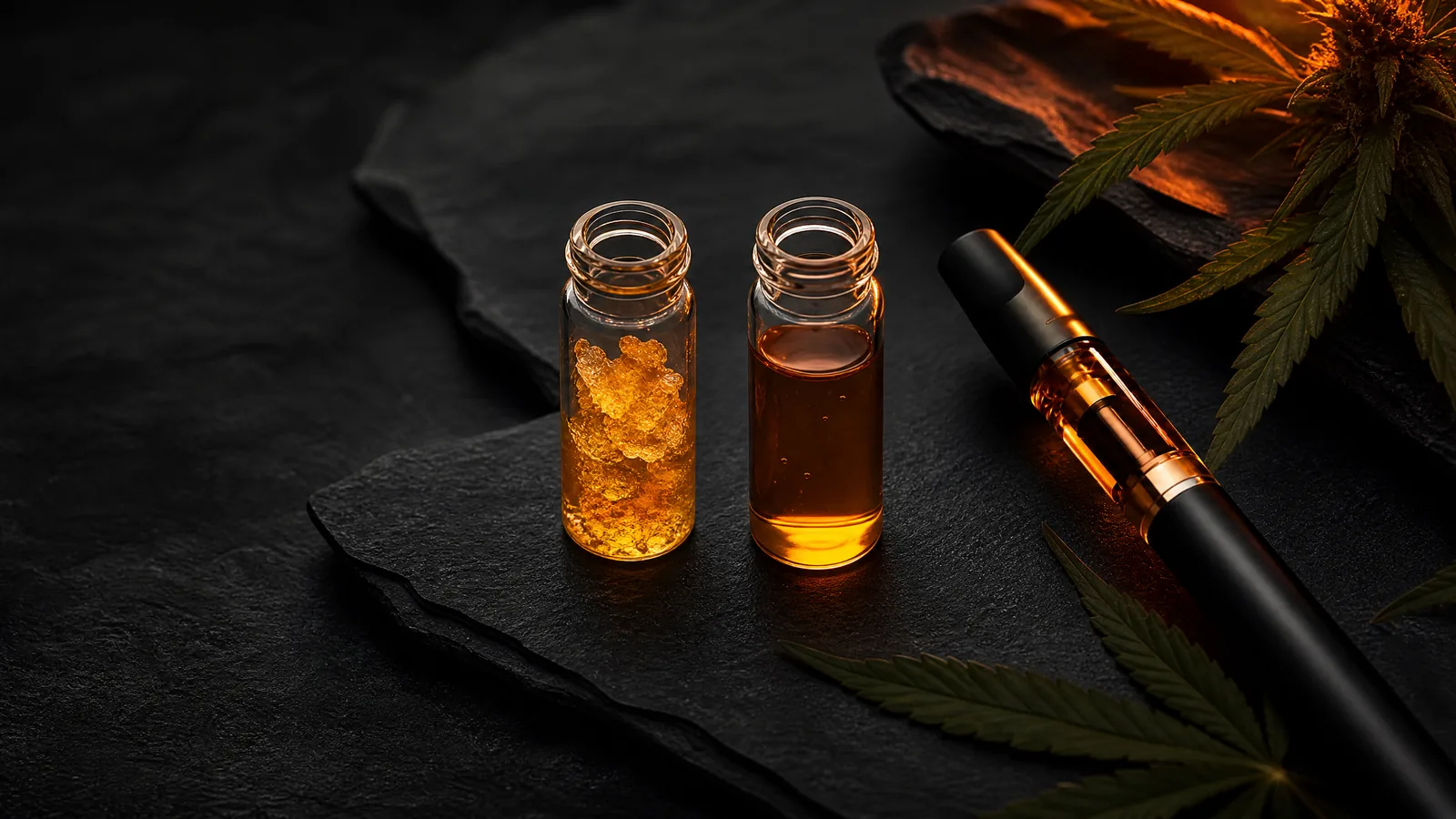
Live Resin vs Distillate: Why Terpwoods Cartridges Taste Different
Two extraction methods, two very different experiences. Here’s what separates live resin from distillate, and why it matters for flavour and effect.


If you’ve compared a Terpwoods live resin cartridge against a standard distillate cart side by side, you’ve probably noticed the flavour difference immediately – live resin tends to taste closer to the actual plant, with more nuance and less of the flat, one-dimensional sweetness common in reintroduced-terpene products. That difference comes down entirely to how the extract is made.
What Is Distillate?
Distillate is produced by extracting cannabinoids from plant material and then refining that extract through a distillation process that isolates and concentrates specific compounds – typically THC – to a very high purity, often 90%+. This process is highly effective at producing potent, consistent oil, but it strips out the plant’s natural terpenes almost entirely in the process. That’s why most distillate-based products require terpenes to be added back in afterward, either using cannabis-derived terpenes or botanically-derived equivalents.
What Is Live Resin?
Live resin takes a fundamentally different approach. Instead of starting with dried, cured plant material, live resin extraction begins with cannabis that’s flash-frozen immediately after harvest – before drying or curing ever takes place. This preserves the plant’s original terpene and cannabinoid profile far more completely than dried-material extraction, because the volatile aromatic compounds that would normally degrade during drying and curing are locked in at their freshest state. The resulting extract retains a much broader, more authentic terpene spectrum specific to that individual strain.
The Key Differences at a Glance
| Factor | Distillate | Live Resin |
|---|---|---|
| Starting Material | Dried, cured plant | Fresh-frozen plant |
| Natural Terpenes Retained | Minimal – mostly removed during refinement | Significant – much of the original profile preserved |
| Flavour Complexity | Simpler, relies on reintroduced terpenes | More nuanced, strain-specific |
| Typical THC Concentration | Very high (90%+) | Moderate to high, terpene content trades off against raw potency |
| Production Cost | Lower | Higher – freezing and specialised extraction add cost |
Why This Matters for Flavour
Terpenes are the aromatic compounds responsible for the distinct smell and taste of any given cannabis strain – the citrus notes in a Key Lime profile, or the earthy depth in something like Chomsky. Distillate-based products can only reproduce these characteristics using added terpenes, which get close but rarely match the full complexity of a strain’s natural chemistry. Because live resin preserves a much broader slice of the original terpene profile – often 100+ distinct compounds rather than a handful of dominant ones – the flavour tends to read as rounder, more layered, and more “true to strain.”
Does Live Resin Feel Different, Not Just Taste Different?
Many users report that live resin products feel qualitatively different in effect, not just flavour – often described as smoother or more nuanced. This is sometimes attributed to the “entourage effect,” a theory that terpenes and cannabinoids interact synergistically to shape the overall experience beyond what THC percentage alone would predict. This remains an active area of ongoing research, but it’s consistent with why many experienced users specifically seek out live resin products over standard distillate, even at a higher price point.
The Terpwoods Lineup
Every product in the Terpwoods line is built around this fresh-frozen, live resin extraction process, offered in 1-gram format across a range of strain-specific profiles. Because live resin production is a more involved process, expect Terpwoods pricing to sit slightly above our standard distillate-based carts – a trade-off many flavour-focused users consider well worth it. Full terpene breakdowns for each Terpwoods batch are published on our Lab Results page, so you can see exactly which terpenes dominate a given strain before you buy.
Which Should You Choose?
- Choose distillate (like our standard Dabwoods Carts) if you want maximum potency at a lower price point and don’t prioritise nuanced flavour differences between strains.
- Choose live resin (Terpwoods) if flavour authenticity and strain-specific character matter to you, and you’re comfortable paying a premium for a more involved extraction process.
Storage Tips Specific to Live Resin
Because live resin retains more volatile terpenes, it’s slightly more sensitive to heat and light exposure than distillate. Store live resin cartridges upright, away from direct sunlight, and at stable room temperature to preserve flavour for as long as possible – see our full cartridge maintenance guide for more detail.
Frequently Asked Questions
Is live resin stronger than distillate?
Not necessarily in raw THC percentage – distillate is often more concentrated. Live resin’s advantage is flavour complexity and, for many users, a more rounded overall effect.
Why does live resin cost more?
The fresh-freezing and specialised extraction process required to preserve the plant’s original terpene profile is more labour- and equipment-intensive than standard distillation.
Is Terpwoods lab tested like the rest of the lineup?
Yes – every Terpwoods batch goes through the same third-party testing for potency, pesticides, and heavy metals as every other Dabwood product.
The Flash-Freezing Process Step by Step
Live resin production begins in the field or immediately after harvest, when cannabis plant material is flash-frozen – typically using cryogenic temperatures well below standard freezer conditions – within hours of being cut. This speed is critical: the moment cannabis is harvested, enzymatic processes begin degrading its volatile terpene content, which is exactly what standard drying and curing (a process that can take days to weeks) allows to happen extensively. By freezing near-instantly, live resin production effectively pauses this degradation at a point much closer to the plant’s living chemical state, preserving a terpene profile that dried-material extraction simply cannot replicate.
Extraction From Frozen Material
Once frozen, the plant material is processed using extraction methods – commonly hydrocarbon-based solvents like butane or propane – while kept at low temperatures throughout the process. Maintaining this cold chain during extraction is essential, since warming the material at any stage risks losing exactly the volatile compounds the flash-freezing was meant to preserve in the first place. This is one of the reasons live resin production requires more specialised equipment and tighter process control compared to standard distillate extraction from dried material, which doesn’t require the same cold-chain discipline.
Why Terpene Count Matters More Than You’d Think
A typical cannabis strain can contain over 100 distinct terpene and terpenoid compounds, each contributing something to the overall aroma and flavour profile, though usually a handful of dominant terpenes account for most of the recognisable character. Standard distillate production, by stripping out virtually all of this complexity and then reintroducing a simplified terpene blend, effectively reduces a potentially 100+ compound profile down to a handful of reintroduced flavour compounds. Live resin retains a meaningfully broader slice of this original complexity, which is why side-by-side comparisons often reveal a noticeably rounder, more layered flavour experience even when the dominant terpene (say, limonene or myrcene) is nominally the same between two products.
Batch Variation in Live Resin
Because live resin preserves more of a specific harvest’s natural chemical variation, you may notice subtle differences between batches of the same named strain over time – this reflects genuine variation in growing conditions, harvest timing, and plant genetics rather than any inconsistency in production quality. Standard distillate, by contrast, tends to be more uniform batch to batch precisely because the reintroduced terpene blend is a controlled, standardised addition rather than a naturally preserved profile. Neither approach is inherently better here – it’s simply a trade-off between natural variation and manufactured consistency.
How to Taste the Difference Yourself
If you want to genuinely compare live resin against distillate side by side, try alternating between a Terpwoods cartridge and a standard Dabwoods Cart of a similar strain type on the same day, with a short break between each. Pay attention not just to the initial flavour on inhale but to the “finish” – the aftertaste and aroma that lingers after exhaling. Live resin products often show more complexity specifically in this finish, where reintroduced-terpene distillate tends to taste more uniform from first draw to last.
Live Resin Pricing Context
The premium associated with live resin products reflects genuine additional production costs – specialised cold-chain equipment, more careful handling, and generally lower yield efficiency compared to standard distillate extraction from dried material. This isn’t a marketing markup; it’s a direct reflection of a more resource-intensive production process required to preserve the terpene complexity that defines the category.
Live Resin’s Place in the Broader Concentrate Category
Live resin sits alongside other “live” extraction categories – live rosin, live budder, live sugar – that all share the same fundamental principle of preserving fresh, unfrozen plant chemistry rather than working from dried, cured material. Each of these formats differs slightly in extraction method and final texture, but all trace back to the same core insight that drove the original development of flash-freezing as a preservation technique for cannabis extraction.
How Curing Traditionally Shaped Cannabis Flavour
Before live resin extraction existed as an option, curing was considered an essential step for developing a cannabis strain’s flavour profile – the slow drying and aging process was understood to mellow harsh, “green” plant notes and develop more complex aromatic characteristics over time. Live resin extraction essentially bypasses this traditional maturation process entirely, capturing the plant’s chemistry at a different point in its lifecycle and producing a genuinely different – not simply “better” or “worse” – flavour outcome than a well-cured, traditionally processed distillate.
Terpene Degradation Rates: A Closer Look
Different terpenes degrade at different rates when exposed to standard drying and curing conditions, meaning a strain’s live resin profile and its dried/cured distillate profile from the same plant can differ not just in total terpene quantity but in which specific terpenes remain most prominent. This is part of why some strains show a more dramatic flavour difference between their live resin and distillate versions than others – it depends on the specific terpene composition of that individual strain and how sensitive those particular compounds are to the degradation that occurs during drying.
Consumer Trends Toward Live Extraction Methods
Across legal cannabis markets globally, live resin and related live-extraction products have seen consistent growth in consumer preference over recent years, reflecting a broader trend toward flavour-forward, strain-specific products rather than generic, interchangeable options. This trend mirrors similar patterns in other consumer categories – craft beverages, specialty coffee – where authenticity and traceable origin increasingly matter to a segment of consumers willing to pay a premium for it.
What “Sauce Consistency” Tells You About a Live Resin Product
Within the live resin category, texture and consistency can vary depending on exact extraction parameters – some batches present as a more liquid “sauce,” while others are thicker or contain visible crystalline structure within the terpene-rich liquid. This visual variation is generally a normal reflection of natural cannabinoid content and terpene ratio rather than an indication of quality difference, though it’s part of what makes live resin a more visually distinctive category compared to the uniform appearance of standard distillate.
Educating Yourself Further on Extraction Science
If this guide has sparked genuine interest in extraction methodology beyond live resin specifically, the broader field of cannabis extraction science continues to develop new techniques and refinements. Following credible industry publications and lab testing methodology updates can deepen your understanding well beyond what any single product guide can cover, helping you become an increasingly informed buyer across whichever product categories interest you most.
Making an Informed Choice Between the Two
Neither live resin nor distillate is objectively superior – they represent different priorities in cannabis extraction, one favouring maximum flavour authenticity and the other favouring production efficiency and consistency. Armed with the technical understanding in this guide, you’re now equipped to choose based on what actually matters to you for a given purchase, rather than choosing based on marketing language alone.
Where to Start If You Want to Try Live Resin
If you’ve never tried a live resin product before, starting with a single Terpwoods cartridge in a strain profile that appeals to you based on its listed terpene breakdown is a reasonable way to experience the category firsthand. Comparing that experience against a standard distillate cart you’re already familiar with will likely make the practical difference between the two extraction methods much clearer than any written description could achieve on its own.
How Climate and Growing Conditions Influence the Final Product
Because live resin captures a plant’s chemistry closer to its natural state, factors like growing climate, harvest timing, and even weather conditions in the days leading up to harvest can influence the final terpene profile more noticeably than they would in a heavily processed, standardised distillate. This is part of what gives live resin its more “craft” character compared to the more industrially consistent nature of distillate production – a trade-off between natural variation and manufactured uniformity that’s worth understanding as you explore the category further.
A Final Comparison Worth Remembering
Think of the distillate-versus-live-resin choice as similar to choosing between a mass-produced, consistently blended product and a smaller-batch, more variable but more characterful alternative in many other consumer categories – coffee, wine, chocolate. Neither approach is wrong, and which you prefer often comes down to whether you value predictability or authenticity more highly for a given purchase.
The Bottom Line for Flavour-Focused Buyers
If there’s one takeaway from this entire comparison, it’s this: if flavour authenticity genuinely matters to your enjoyment of a vape product, live resin is worth the premium. If potency-per-euro and consistency matter more, distillate remains an excellent, fully lab-tested option that shouldn’t be dismissed simply because it’s the more affordable choice. Both represent legitimate, quality approaches to cannabis extraction – the right one depends entirely on what you personally value most in the experience.
Understanding Harvest Timing’s Effect on Live Resin Quality
The precise moment of harvest – plant maturity, time of day, even recent weather – can measurably affect a live resin extract’s final terpene profile, since these factors influence the plant’s chemical state at the exact moment of flash-freezing. This sensitivity to harvest timing is part of why live resin production requires closer coordination between cultivation and extraction teams compared to distillate production, where dried, cured material provides a more stable, forgiving starting point regardless of minor harvest timing variation.
Live Resin’s Growing Role in Premium Product Lines
As the broader cannabis vape market matures, live resin has increasingly become the format of choice for brands specifically targeting flavour-conscious, experienced consumers willing to pay a premium for authenticity over pure cost efficiency. Our Terpwoods line reflects this same market positioning – a premium, flavour-first option sitting alongside our more cost-efficient standard distillate lines, giving customers genuine choice depending on what they prioritise for any given purchase.
Closing Thoughts on Extraction Method as a Buying Criterion
Understanding extraction method – live resin versus distillate – gives you a genuinely useful additional lens for evaluating any cannabis vape purchase, not just within our catalogue but across the broader market generally. This single piece of knowledge, once understood, will inform your purchasing decisions for as long as you continue buying vape products, regardless of which specific brands you choose to shop from in the future.
Taste the difference for yourself with strain-specific live resin.
Shop Terpwoods